You've got a Stiga that needs a part. Maybe it's a brand-new Aero battery mower, maybe it's an Estate tractor you've owned for fifteen years, maybe it's a Villa Senator from 2001 that's outlasted three sheds. Whatever it is, you've walked out to the machine, jotted down whatever numbers you can read off the ID sticker, and now you're worrying you'll order the wrong part.
That worry is understandable. Stiga has been making garden machinery since 1958, and the brand's parts catalogue spans almost seventy years of production. The range covers walk-behind petrol mowers, ride-on lawn tractors that cost more than a small car, battery-powered everything, robotic mowers that have been in production since 2012, and high-end front-deck riders with proprietary engines built specifically for the machine. That breadth is a strength because parts for almost every Stiga ever sold are still available. It's also a complexity because the right part depends on knowing exactly which version of your machine you have.
There's a system that prevents you ordering the wrong thing. It's the system Stiga itself uses to identify parts, and once you know how it works, it's reasonably simple. This guide walks you through it, machine by machine, and explains why parts from Mountfield, Alpina, ATCO and Castel often fit your Stiga (and vice versa). It also shows the three different ways to find the right part: the interactive diagrams for confident self-service, the Quick Reference Guides for verification, and the free Find My Part service for anything that's still uncertain.
If at any point you'd rather skip the article and let us identify the part for you, just click the Contact Us button at the bottom of any page on the site, send us a photo of your machine's ID sticker, and we'll find what you need.
What's the first thing to look for on your Stiga machine?
The single most useful piece of information on any Stiga machine is the Art.N, short for Article Number. Every Stiga has an ID sticker somewhere on the body, usually a small adhesive label with several lines of text and numbers. The Art.N is one of those lines. It looks something like 2L0482048/M21.
This number is the key to everything. The model name (for example "Estate Senator 14") tells you the family: a mid-range lawn tractor with a particular feature set. But Stiga has produced the Estate Senator 14 across multiple years, with different engine options and small specification changes between production runs. Each production run gets its own Art.N.
So if you take just the model name to a parts catalogue, you might be looking at three or four sets of parts diagrams and wondering which one matches your machine. If you take the Art.N, there's only one set of diagrams that applies, and the parts you order from those diagrams will fit.
Where to find the ID sticker on common Stiga machines
The location varies by machine type. Here's where to look on the most common Stiga categories:
Petrol lawnmowers (Multiclip, Combi, Collector, Primo): Usually on the deck near the rear, or under the handlebar bracket. Some are on the underside of the deck. Tip the mower carefully to look.
Lawn tractors and ride-ons (Estate, Tornado, Combi, Swift series): Typically on the frame under the seat, or on a panel near the steering column. You may need to lift the seat to see it clearly.
Villa series ride-ons: Often on the rear frame or under the seat. The older Villa Senator from 2001 has the plate riveted to the chassis behind the cutting deck.
Park series and Front Deck Riders: On the chassis behind the front cutting deck, or under the seat on newer Park models.
Battery machines (Aero, e-Park, ePower handheld kit): On the underside of the housing, or on a rear panel. On battery chainsaws and brushcutters, look around the motor housing.
Autoclip robot mowers: Underside of the chassis, or inside the battery compartment.
Handheld petrol kit (SB22 brushcutter, SP-series chainsaws): On the motor housing, sometimes under a removable cover.
Serial number, model number, Art.N: what's the difference?
Three numbers, three different jobs.
The model number identifies the machine family. "Estate Senator 14", "Multiclip 47 S", "Autoclip 225 S", "Villa SENATOR". A model can have multiple production runs over its life.
The Art.N (Article Number) identifies the specific production run. 2L0482048/M21 is one particular version of a model. Each production run has its own Art.N, and the parts diagrams for that production run are unique.
The serial number identifies the individual machine within a production run. It's useful for warranty registration and service history, but for ordering parts the Art.N is what matters most.
When ordering, the Art.N is the number you want. The model number alone is sometimes enough, but only if your model has had a single production run, which is rare on Stiga machines that have been in the range for several years.
What if the ID sticker is missing or unreadable?
It happens. Stiga machines often live in damp sheds, get dragged across rough ground, and the stickers can degrade over time. Older Villa, Tornado and Estate machines are particularly likely to have missing or faded stickers.
First, check the metal directly under or near where the sticker should be. Stiga sometimes stamps the production number into the chassis as a backup. On Estate and Park tractors, look under the seat or behind the steering column. On Villa series, check the rear frame.
Second, if you genuinely can't find it, click the Contact Us button at the bottom of any page on this site and send us a photo of the machine, including any visible numbers or labels you can find. Tell us what you remember: when you bought it, roughly what it cost, where from. Often we can identify the production run from a photo and a few details.
Why Mountfield, Alpina, ATCO and Castel parts often fit your Stiga
Stiga is the original brand in a family of five.
The company was founded in 1934 by Stig Hjelmquist in Tranås, Sweden, originally to produce table tennis equipment (still a major Stiga product line today). Garden machinery production began in 1958, and by 1976 Stiga had what was then the largest motor mower factory in the Nordic countries, an 18,000 square metre plant in Sweden inaugurated by King Carl XVI Gustaf.
In 2000, Stiga was acquired by Castelgarden SpA in Italy, which had just merged with Alpina Professional & Garden SpA. That combined group bought the British brand Mountfield (founded 1962 in Maidenhead, Berkshire) and Castel/Twincut/Lawnking. The whole group operated under the name GGP (Global Garden Products) from 2000 to 2017. In 2013, GGP acquired British brand ATCO. In 2017, the group officially renamed itself STIGA Group, restoring the original brand name at corporate level.
Today, STIGA Group is headquartered in Castelfranco Veneto, Italy, with thirteen European subsidiaries, and sells products in more than seventy countries. Mountfield, Alpina, ATCO, Castel and Stiga itself are all designed and manufactured under the same corporate roof, in the same factories, by the same engineering teams.
The deeper history of the corporate group, including the brand's evolution from table tennis to lawn tractors, is covered in our Stiga history blog post.
What this means in practice: many parts on Stiga machines are physically identical to parts on Mountfield, Alpina, ATCO and Castel machines. Same blade, same spark plug, same drive cable, same starter motor, sometimes even the same engine. The badge changes; the part doesn't.
Four concrete examples from our own stock:
The Champion RC12YC spark plug (part 9400-0244-00, around £5) fits the Stiga Combi 748 S, Multiclip 47 S, Collector 43, three Alpina mowers (C92G, A92HG, A102HG), eleven different Mountfield models, and multiple Castel/Twincut/Lawnking TRE-series and WBE-series machines.
The Stiga Multiclip Blade 48/50cm (part 181004146/0) fits the Stiga Multiclip 750 S and the Mountfield 5030 PD INOX petrol rotary mower. Same blade, same SKU, two badges.
The starter motor (part 118550214/0) fits the Stiga Primo, the Alpina C92G / A92HG / A102HG range, Mountfield 1538H-SD / 1538M-SD / 1430H lawn tractors, and Castel TRE0701 / TRE0702 / TRE0801 ride-ons.
The spring (part 125430213/0) fits dozens of Stiga Estate, Tornado and Combi tractors, plus a long list of Alpina A-series and C-series tractors, Mountfield T-series, 1430, 1530 and 1538 ride-ons, and Castel WBE-series and TRE-series machines.
Why this matters for the buyer: if you've got a Stiga model number that's tricky to track down, or you're seeing a part listed under "Mountfield" or "Castel" and wondering if it'll fit, the answer is often yes. The Find My Part service handles all of this. We'll tell you whether a given part is interchangeable or not, and order the right one for you.
If you want to browse the related brands directly, the Mountfield, Alpina, ATCO and Castel/Twincut/Lawnking brand hubs are all on the site.
What makes Stiga different from Mountfield, Alpina and Castel
Even with the shared corporate roof and the heavy parts interchangeability, Stiga has genuine differentiators worth understanding. Three in particular matter when you're ordering parts.
Stiga makes its own engines
Most Mountfield machines run a Briggs & Stratton engine or one of the GGP-branded engines (the RS100 OHV, the Series 150 engines RV150 / M150 / SV150). Stiga has gone further and developed its own engines, designed specifically for its higher-end machines.
The ST-series twin-cylinder engines are the headline example. The ST TRE586V (around £300) is a Stiga-designed engine fitted to several Estate and Park tractors. Stiga describes these engines as developed for the torque and performance curves of the specific machines they power, rather than being generic units adapted to the application.
Stiga also offers a three-year warranty on twin-cylinder ST engines in residential use, which is unusually long for residential garden machinery (most equivalent engines come with a one or two year warranty).
For owners: if you have a recent Stiga Estate or Park tractor and need engine parts, you're looking at Stiga-designed components rather than third-party engines. The fitment lists and parts diagrams reflect this. Browse the Stiga Engines parts group for the full range.
Stiga pioneered the robotic mower in the group
Stiga launched the Autoclip robotic mower range in 2012, earlier than most consumers realise, and earlier than any of the other STIGA Group brands. The Autoclip range has been continuously developed since then, with model generations released in 2017 and beyond.
Models in the field today span entry-level (Autoclip 100, 125, 140) through to large-area machines (Autoclip 225 S, 230, 300, 500). Each model has its own parts diagram on the site.
The most common parts needed: cutting blades (the small triangular floating blades wear out from normal use and stone impact), drive wheels, charging stations, perimeter wire connectors, sensors, and battery packs. Older Autoclip models (the 2012-2014 generations) sometimes have superseded parts where Stiga has updated the original component.
The ePower battery platform is cross-machine
Stiga's modern battery products share the ePower 20V battery platform. One battery family, multiple tools. If you've bought a Stiga ePower-compatible mower like the Aero 132e (a patented air-cushion cordless mower designed for smaller lawns), the same 20V batteries also fit other 1-series Stiga cordless tools: chainsaws, hedgetrimmers, brushcutters, blowers.
Larger ePower battery formats power machines like the e-Park 220 (a full-size battery ride-on). Confirm fitment by checking the battery model number against your machine's compatible list. If you're not sure, send the details via Contact Us and we'll verify.
This cross-machine compatibility matters when you're ordering replacement batteries or chargers. Generic third-party batteries don't fit Stiga ePower machines and shouldn't be used. Genuine Stiga ePower batteries are designed to communicate with the machine's electronics, and the warranty depends on using OEM batteries.
How to find parts for your specific Stiga machine
Stiga's range is broad: petrol mowers from 41cm to 53cm cutting widths, lawn tractors at every price point from entry-level to professional, the Villa range that spans decades, battery-powered machines built on the ePower platform, robotic mowers, handheld petrol kit. This section walks through each category, tells you which model families belong in it, and points you to the right parts.
If at any point you're not sure which category your machine belongs to, scroll down to the "Three ways to find the right Stiga part" section, or just click the Contact Us button now.
Petrol lawnmowers (Multiclip, Combi, Collector, Primo)
Stiga's walk-behind petrol lawnmower range covers four main sub-families:
- Multiclip series: Multiclip 50, Multiclip 47 S, Multiclip 750 S, Multiclip Pro 53S, plus older Multiclip models still in service. The name reflects the mulching focus: blades and decks designed for repeated fine cutting of grass clippings rather than collecting them.
- Combi series: Combi 748 S. The flexible option: collect, mulch or side-discharge depending on configuration.
- Collector series: Collector 43. Bagging-focused, with a rear grass collection box.
- Primo series: Primo. The entry-level petrol mower, widely sold and parts well-supported.
Engines in this category are usually Briggs & Stratton or one of the GGP-branded engines. Common replacement parts: blades (the Multiclip Blade 48/50cm 181004146/0 is the cross-brand example), spark plugs (Champion RC12YC fits this whole range), drive cables, recoil starter rope and spring, air filters, fuel filters, fuel system parts including the fuel tap and primer bulb.
Browse the Stiga Petrol Lawnmowers parts group, check the Stiga Quick Reference Guides, or send us a photo via the Contact Us button if you're not sure which model you have.
Lawn tractors: Estate, Tornado, Combi, Swift
The serious end of the Stiga range. These are higher-value machines, and the parts are correspondingly higher-value: transmissions, transaxles, cutter decks, starter batteries, alternators, full electrical looms.
Model families include:
- Estate series: Estate Royal, Collector, President, Pro 20, Pro 22, Senator 14, Royal Pro 17, Royal 19, Collector HST, plus newer numbered models (384, 384 M, 584e, 598, 598 W, 798, 798 W, 798e, 7102 W, 7102 W Special, 9102 WX, 9122 W, 9122 WX).
- Tornado series: 5108, 5108 W, 7108e, 7108 W Special, 398, 398 M, 398e, 598e, 9121 W.
- Combi tractors: Combi 166, Combi 372.
- Swift series: Swift 372e.
Cross-brand interchangeability is particularly strong in this category. The spring 125430213/0 alone fits fourteen different Stiga ride-on models plus a long list of Mountfield, Alpina and Castel tractors. The same applies to engines, transmissions, transaxles, brake components and many electrical parts.
Electrical parts are a significant part of this category. Starter batteries (typically 12V on petrol ride-ons), alternators, ignition switches, safety microswitches, and wiring looms all wear and fail with age. If your tractor turns over slowly, doesn't crank at all, or has intermittent electrical faults, the part is almost certainly available.
Browse the Stiga Tractors parts group, check the Quick Reference Guides, or send a photo via Contact Us.
Villa series ride-ons
A long-running Stiga ride-on range with extraordinary generational breadth. Some Villa machines in service today are over twenty years old, and parts are still available for many of them.
Model families include:
- Numbered series: Villa 8 Series, 9E, 11 Series, 1102E, 12 Series, 13 Series, 1302E, plus the 13-2722-11 model from 2001 (still well-supported).
- HST variants: Villa 16 HST, 320 HST, 520 HST. The HST stands for hydrostatic transmission.
- Standalone models: Villa 2000, FM (Black line), Jubilee, Millenium.
- Mark II generation: Villa II Elegance, II Prestige, II Royal.
- Premium variants: Villa Classic Series, Comfort, De Luxe, Elite, Excellence, Master Series, President Series, Senator.
If you've got a Villa that's been in the shed for decades, the parts are very likely still available. The diagrams are organised by year and serial number, and Stiga has consistently maintained parts availability for the line.
Browse the Stiga Villa parts group, or send a photo if you're unsure which generation you have.
Park series and Front Deck Riders
The Park range is Stiga's front-deck rider line: cutting deck out front, machine behind, designed for visibility into the cutting line and for accessing tight corners that conventional ride-ons can't reach.
Models include:
- Park 120 (2019)
- Park Compact 16
- Park Compact 16 4WD (unusual at this price point: four-wheel drive on a front-deck rider)
- Park Pro 16
- Park Pro 20
- Park PR020
Common parts: cutting decks and deck spindles, transmission components (these machines use hydrostatic and 4WD drivetrains), starter batteries, alternators, electrical looms, drive belts.
Browse the Stiga Front Deck Riders parts group, or send a photo via Contact Us.
Battery mowers and the ePower system
The newest section of the Stiga range, and the fastest-growing. Stiga has invested heavily in the ePower platform since 2017.
Key machines:
- Aero 132e: Stiga's patented air-cushion cordless mower. The deck "traps" air underneath, increasing air pressure and lifting the whole mower so it hovers. Runs on two ePower 20V batteries. Designed for smaller lawns (up to 100 m² per charge).
- e-Park 220: Battery-powered ride-on built on the larger ePower platform.
- Cordless handheld kit: chainsaws, hedgetrimmers, brushcutters, blowers and blower/vacs, all sharing the 20V ePower battery platform.
Common replacement parts: battery packs, chargers, blades, deck assemblies, switches, safety keys, charging connectors. Battery and charger fitments are particularly worth double-checking because the ePower platform has evolved across generations and not every battery fits every machine.
Autoclip robotic mowers
Stiga's robotic range, in continuous production since 2012. The Autoclip line is one of the longer-established robotic mower platforms in the European market, with model generations including:
- Entry-level: Autoclip 100, 125, 140
- Mid-range: Autoclip 225 S, 230
- Large-area: Autoclip 300, 500
The Autoclip 225 S (notably the 2017 generation) is one of the most common models still in active service. If you own one and need parts, send us the model number and a photo of the underside.
Common replacement parts: cutting blades (the small triangular floating blades wear out from normal cutting and stone strikes), drive wheels and tyres, charging stations, perimeter wire and connectors, sensors, battery packs, replacement bodywork covers.
Brushcutters, chainsaws, hedgetrimmers, blowers
The handheld petrol range. Smaller engines, tighter parts inventory dominated by consumables and engine wear items.
Model families include:
- Brushcutters: SB22 and other Stiga brushcutter models.
- Chainsaws: SP370, SP420, SP510. These share components with Mountfield's MC-series chainsaws and Castel's XB-series.
- Hedgetrimmers and blowers: various petrol and battery-powered models across the Stiga range.
Cross-brand interchangeability is significant here. The Champion RCJ7Y spark plug (part 3210024) fits Stiga SP510, SP370, SP420 and SB22, plus the entire Mountfield MC-series chainsaw range, the MB and MT brushcutters, the MBL blower, and several Castel XB-series machines.
Browse the Stiga Brushcutters/Trimmers parts group and the Stiga Chainsaws parts group for the full range.
Pressure washers, electric lawnmowers, decks
Three smaller categories that are still well-stocked on the site:
- Pressure washers: accessories, hoses, jets, adaptors and fittings, replacement guns. Stiga pressure washers share many components with the wider STIGA Group range.
- Electric lawnmowers: corded entry-level mowers, generally lower-cost machines with proportionally lower-cost parts.
- Decks: replacement and accessory cutting deck components for ride-on lawn tractors and front-deck riders. Includes blade spindle assemblies, deck shells, anti-scalp wheels, deck adjustment hardware.
Each has its own parts group on the Stiga brand hub.
The five Stiga parts most owners need at some point
Every Stiga owner will, eventually, need most of these. They're the parts that wear out from normal use: not faults, just consumables and service items.
1. Replacement blades
Mower blades wear down from normal cutting and dull rapidly if the lawn contains stones, twigs or anything else the previous occupant of the garden has forgotten about. Sharpening extends their life. You can do this yourself with a file, or have a dealer do it. But eventually the blade is too thin or too pitted to sharpen safely, and replacement is the only option.
Stiga blade fitments vary by deck size. Walk-behind blades come in 41cm, 46cm, 48cm, 50cm and 53cm widths; ride-on cutter deck blades come in various widths depending on the cutting deck size on the tractor.
A notable example is the Stiga Multiclip Blade 48/50cm (part 181004146/0), which fits both the Stiga Multiclip 750 S and the Mountfield 5030 PD INOX. If you're not sure which blade fits your machine, send a photo of the deck and the ID sticker.
2. Spark plugs
The single most commonly replaced service part. Spark plugs should be replaced annually as part of a normal service schedule, or sooner if you've had starting problems.
Different Stiga engines need different plugs. A short reference:
- Champion RC12YC (part
9400-0244-00) fits many of the larger Stiga petrol mowers and ride-ons, including the Combi 748 S, Multiclip 47 S, Collector 43, Primo, and various Estate ride-ons. - Champion RCJ7Y (part
3210024) fits the handheld petrol kit: SB22 brushcutter, SP-series chainsaws.
For Stiga twin-cylinder ST-series engines (the proprietary engines fitted to higher-end Estate and Park tractors), the plug specification is engine-specific. Check the engine code on the ID plate, or use the Find My Part service if you're unsure.
3. Drive cables, clutch cables and belts
Self-propelled mowers have a drive cable that runs from the handlebar control to the wheel-engagement clutch. Over time the cable stretches, the inner wire frays, or the outer sheath splits, and the mower stops self-propelling.
Clutch cables on ride-ons and walk-behinds with a blade-engagement clutch work in similar ways and wear in similar patterns. Both types of cable are model-specific. The cable for a Multiclip 47 S from 2014 is not the same as the cable for the Multiclip 47 S from 2018. This is where the Art.N matters most.
Belts on ride-on mowers, lawn tractors and front-deck riders wear in the same way. PTO belts (the ones driving the cutter deck) tend to go first, followed by the main drive belts. Annual inspection extends their life; eventual replacement is unavoidable.
4. Air filters, fuel filters and maintenance kits
Routine service items. Both should be checked annually and replaced when contaminated or damaged. A clogged air filter robs the engine of power and increases fuel consumption; a clogged fuel filter starves the carburettor and causes intermittent running.
The simplest way to handle these is to buy a maintenance kit (sometimes called an engine service kit), which bundles the air filter, fuel filter, spark plug and sometimes oil into a single product. The site's Engine Service Kits category holds the relevant kits, including kits labelled for Stiga, Mountfield and GGP engines.
5. Recoil starter ropes and springs
The pull-start mechanism on a petrol mower is one of the most-used parts of the machine. Pull the rope a hundred times a season, every season, for ten years, and eventually something snaps. Usually it's the rope itself. Sometimes it's the recoil spring inside the housing.
Both are inexpensive parts. The frustration is that until they're replaced, the mower won't start, and a non-starting mower is essentially a piece of garden sculpture.
Three ways to find the right Stiga part
Most Stiga owners reading this guide already know roughly what they need. The question is which route works best for finding the specific part for the specific machine. We've built three different routes because Stiga owners ask for help in three different ways.
Option 1: Use the interactive Stiga parts diagrams
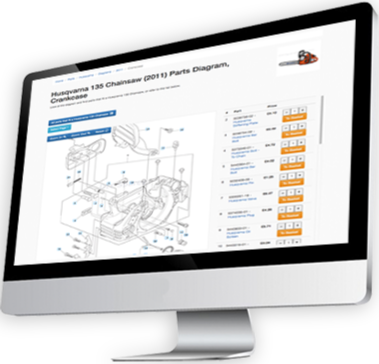
The technical, self-serve option. Browse by machine series and year. Every Stiga model from the Villa Senator (2001) through to the latest Autoclip robot mower has its own diagram set. Each diagram is an exploded view of a specific assembly: cutter deck, engine, transmission, electrical, controls. Every component is numbered and the part number is listed alongside.
To use the diagrams:
- Start at the Stiga parts hub and choose your product group (Petrol Lawnmowers, Tractors, Front Deck Riders, etc.)
- Choose your machine from the list
- Select the year or serial number range that matches your machine's Art.N
- Browse the diagrams page by page to find the part you need
Best for: owners who know their machine and Art.N, and want to identify a specific part visually before ordering. Especially useful for ride-on tractors and front-deck riders, where the diagrams show how individual components fit together within larger assemblies.
Option 2: Check the Stiga Quick Reference Guides
The verification option. Quick lookup tables for spark plugs by machine, blade sizes by deck width, common service intervals, and model identification by serial number. The Quick Reference Guides are part of the site's 80+ Help/Advice library, and the Stiga-specific guides include guides on identifying older Stiga models, the right spark plug for each engine family, blade fitment by deck size, and service interval recommendations.
Best for: owners who want to verify a part number, confirm a specification, or learn about a maintenance interval before ordering. Also useful for confirming whether your machine takes the same part as a related Mountfield or Castel model.
Option 3: Send us a photo via the Contact Us button
The free part identification safety net. Click the Contact Us button at the bottom of any page on this site, send us a photo of your machine's ID sticker plus a description of the part you need, and we'll find it for you. Free of charge, no obligation, no requirement to have bought from us before.
Best for: any case where the first two routes don't get you there. Specifically:
- Missing or unreadable ID sticker
- Older Villa, Tornado or Estate model where the diagrams are hard to navigate
- Cross-brand fitment uncertainty ("is this Mountfield part the same as my Stiga part?")
- Obsolete or superseded part questions
- Anything that needs human verification before ordering
A few things worth knowing about the Find My Part service:
- We sell genuine OEM spare parts only: no aftermarket copies, no unbranded equivalents. The part you receive is the part the manufacturer would supply to a dealer.
- We ship worldwide from our warehouse in Shaftesbury, Dorset, on a tracked service. STIGA Group sells in seventy-plus countries, and we ship Stiga parts to most of them: the US, Canada, Australia, New Zealand, Ireland, and across Europe.
- The team has been working with STIGA Group brand parts since the company was founded in 2012. Stiga, Mountfield, Alpina, ATCO and Castel are core to what we do.
Common questions Stiga owners ask
How old is my Stiga, and can I still get parts for it?
You can usually still get parts. Stiga has maintained excellent parts availability across its range, going back decades. The 2001 Villa Senator (13-2722-11) is still well-supported. Older Multiclip, Combi, Park and Estate machines from the 1990s and 2000s are mostly still serviceable.
Some specific parts on the very oldest machines have been discontinued by the manufacturer, but in many cases an equivalent or superseded part is available. Stiga regularly updates original part numbers with newer equivalents that fit and work the same way.
If your machine has a production year visible on the ID sticker, that's the easiest way to confirm parts availability. If it doesn't, send us a photo and we'll tell you what's available.
Are Stiga parts the same as Mountfield parts?
Often yes, often no. Many components are physically identical because Stiga, Mountfield, Alpina, ATCO and Castel all share the same parent company, the same factories and the same engineering teams. Blades, spark plugs, starter motors, springs, drive cables, fuel system components and certain engines (the GGP-branded ones) cross over freely.
Some parts are Stiga-specific. The ST-series twin-cylinder engines fitted to higher-end Estate and Park tractors are designed and built by Stiga, and parts are listed under Stiga only. The ePower 20V battery platform is Stiga-specific. The Autoclip robotic mower components are Stiga-specific.
If you're holding a part number and trying to work out whether it's Stiga, Mountfield, or both, send us the number. Often it's both.
Where are Stiga machines made?
Most modern Stiga machines are designed in Castelfranco Veneto, Italy (STIGA Group headquarters) and manufactured at STIGA Group's European facilities. The Italian plant near the headquarters handles higher-end ride-on lawn tractors and Park-series front-deck riders. The Poprad facility in Slovakia handles a substantial portion of the petrol lawnmower range. Some entry-level battery components and accessories are produced in China.
The original Swedish factory closed many years ago, though the Stiga brand maintains its Swedish heritage. The 1976 18,000 square metre Swedish plant that was once the largest motor mower factory in the Nordic countries is no longer in operation, but the engineering DNA of the Swedish years still influences the brand.
All STIGA Group machines are tested to European quality, safety and emissions standards before release.
Where can I find my Stiga's Art.N if the ID sticker is missing?
Check the metal directly under or near where the sticker should be. Stiga sometimes stamps the production number into the chassis as a backup. On Estate and Park tractors, look under the seat or behind the steering column. On Villa series machines, the plate is usually on the rear frame. On Multiclip and Combi walk-behind mowers, check the underside of the deck or behind the handlebar mounting bracket.
If you can't find it anywhere on the machine, send a photo via the Contact Us button. Tell us what you remember about the machine: when you bought it, where from, roughly what it cost. We can often identify the production run from a photo and a few details.
Do Stiga ePower batteries work in other Stiga machines?
Yes, within the same battery format. The 20V ePower batteries used in the Aero 132e mower also fit other 1-series Stiga cordless tools (chainsaws, hedgetrimmers, brushcutters, blowers). Larger ePower battery formats power the e-Park 220 ride-on and other larger machines.
Confirm fitment by checking the battery model number against your machine's compatible list. If you're not sure, send us the details via Contact Us and we'll verify. We don't recommend using third-party or generic batteries in Stiga ePower machines, because the batteries communicate with the machine's electronics and warranty depends on using OEM batteries.
Are Autoclip robot mower parts still available for older models?
Yes, generally. The Autoclip range has been in continuous production since 2012, and the 225 S and similar 2017-era models are still well-supported for blades, wheels, charging stations and perimeter wire components. Some of the earliest Autoclips (the 100 and 125 from 2012 to 2014) may have superseded parts where Stiga has updated the original component.
If you own an older Autoclip and need parts, send us the model number and a photo of the underside. We'll tell you what's currently available and what equivalents we can supply.
Do you ship Stiga parts outside the UK?
Yes. We ship worldwide on a tracked service, excluding sanctioned territories. STIGA Group sells in seventy-plus countries and we ship Stiga parts to most of them. We regularly send Stiga parts to the US, Canada, Australia, New Zealand, South Africa, Ireland and across Europe.
Shipping rates and delivery times vary by destination. They're calculated at checkout once you've added a part to the basket and entered your delivery address.
What if I'm still not sure which part I need?
Click the Contact Us button at the bottom of any page on this site, send us a photo of your machine's ID sticker and a description of the part you need, and we'll find it for you. Free of charge, no obligation, and no requirement to have bought from us before.
Putting it all together
The whole reason this article exists is to remove the anxiety of ordering the wrong part for your Stiga. The brand's range is unusually broad, the cross-brand parts story is more complex than most consumers realise, and the difference between a Multiclip 47 S from 2014 and a Multiclip 47 S from 2018 isn't obvious until you know to look.
Stiga's parts system is more logical than it first looks. Once you know that the Art.N pinpoints the exact production run, that the same components run across the wider STIGA Group brands (Mountfield, Alpina, ATCO, Castel), and that Stiga has genuine differentiators (the ST-series engines, the ePower battery platform, the Autoclip robotic range), finding the right part becomes a contained problem.
Three routes to get there:
- The interactive diagrams for owners who know their machine and want to self-serve
- The Quick Reference Guides for owners who want to verify a part before ordering
- The Find My Part service for anything that's still uncertain
Stiga has been making garden machinery since 1958. The parts catalogue on this site spans that whole history: from pre-2000 Villa ride-ons to the latest Autoclip robotic mowers and ePower battery machines. Most problems are fixable. Most parts are still available. Most of the worry about ordering the wrong thing goes away once you know the system.
Whichever route works best for you, the Contact Us button is at the bottom of every page on the site, including this one.