You've got a Husqvarna that needs a part. You've found the little metal plate on the machine, and now you're looking at three different numbers wondering which one you actually need.
That confusion is the single most common reason people get in touch with us about Husqvarna parts. Most manufacturers give you one identifying number. Husqvarna gives you three, they all look similarly official, and only one of them will reliably get you to the right parts diagram.
The short answer is that you want the PNC. On the plate it might be printed as 970 55 93-00, and the number you actually use is 9705593-00. That one number identifies the exact variant of your machine, including details like which bar and chain a chainsaw originally shipped with.
The longer answer is what this guide is for. It covers what each of the three numbers does, where the ID plate is hiding on every type of Husqvarna machine (it moves around a lot, and on some chainsaw models it's in a completely different place from others), why McCulloch, Flymo and Jonsered parts often fit your Husqvarna, and what to do when the plate has faded away entirely.
Husqvarna has been manufacturing since 1689, and has been making outdoor power equipment for decades. The parts catalogue runs deep. Almost everything is still available if you can identify the machine properly.
If you'd rather skip the guide and let us do the identifying, click the Contact Us button at the bottom of any page on the site, send a photo of the plate, and we'll find what you need.
The PNC on your Husqvarna, and where to find it
Every Husqvarna machine carries an ID plate or decal, usually a small metal tag or sticker roughly the size of a thumb. On it you'll find three numbers stacked, plus the manufacturer details.

A typical Husqvarna ID plate. The model is 450 II, the serial number is 2023 1807826, and the PNC, the number you need when ordering parts, is 970 55 93-00.
Model, PNC and serial number: what each one is for
The model number is the name you already know. 450 II, 372 XP, 128LD, 226HD60S, LT120. It tells you the machine family, but Husqvarna often produces the same model across several years with running changes between production runs. On its own, the model number will usually get you to a list of diagram sets rather than the one you need.
The PNC (sometimes called the product number code, or listed as the part number on older plates) is the number that matters. It's nine digits, and it identifies your exact machine variant. On the plate it's often printed with spaces for readability, so 970 55 93-00 becomes 9705593-00 when you actually use it. Husqvarna's own documentation notes that this code identifies the machine variant right down to which bar and chain a chainsaw was originally manufactured with.
The serial number identifies your individual machine. On a modern plate it might read 2023 1807826, where the first four digits are the production year. On older professional machines the format was different, typically nine or eleven digits encoding year, week and sequence, so 054200362 would be week 42 of 2005, unit 362. Useful for dating a machine, particularly if you're buying second hand. Not the number you order parts with.
So: model gets you to the family, PNC gets you to the parts, serial tells you how old it is.
Where the ID plate is on your machine
This is where most of the difficulty comes in, because Husqvarna puts the plate in different places depending on the machine type, and sometimes in different places on machines within the same category.
Chainsaws. The model name is usually printed on the side of the recoil assembly, so you can read 450, 460 or 372 XP without hunting. The full plate with the PNC is elsewhere, and there are three or four possible locations:
- Near the oil fill cap on most models
- On the bar side of the saw, underneath the handle, on the 340, 345, 350, 351, 353 and 346XP
- Different again on the 136 and 141
If you can't find it in one place, check the others before assuming it's gone.
Brushcutters and trimmers. The model number is printed on the back of the recoil assembly, so a 128LD will say so where you can see it. The full plate, with model, PNC and serial, is on the base of the machine. It can be a printed sticker or a stamped metal plate depending on age.
Petrol hedge trimmers. The model number is on the top of the unit, which is why a 226HD60S is easy to identify at a glance. The full plate is on the right hand side of the engine housing.
Walk-behind mowers, petrol and battery. The model number decal is usually on the engine cover. The full plate is on the deck itself, either behind the engine, beside it, or on the side of the deck near a rear wheel.
Tractors. The model number decal is on the sides of the hood. The full plate is on the frame under the seat, so you'll need to lift the seat to read it.
Riders. Same as tractors: lift the seat and look at the frame.
Automower. On the underside of the chassis, or inside the battery compartment.
Reading the plate correctly
Two practical points that save a lot of wasted time.
First, the spaces are for readability, not part of the number. A plate showing 970 55 93-00 means a PNC of 9705593-00. When you're typing it into a search box or a parts lookup, leave out the spaces. The same applies to serial numbers: no dashes, no spaces.
Second, plates are often dirty rather than worn out. Chainsaw plates in particular sit in a part of the machine that collects bar oil and sawdust. Before you conclude the numbers have gone, wipe the plate with a rag and a bit of degreaser and take another look with a torch. A surprising number of "unreadable" plates come back to life.
If the plate is missing or unreadable
It happens, particularly on machines that have had a hard life or been stored outside.
Check whether the model name is printed elsewhere on the body, since on chainsaws and trimmers it's often moulded or printed on the recoil housing separately from the plate. That gets you halfway.
If you can't get any numbers at all, click the Contact Us button at the bottom of any page and send us a photo of the machine along with whatever you can tell us: roughly when you bought it, where from, what it originally cost, what it looks like. We identify machines from photographs regularly, and we'd rather do that than have you order the wrong part.
Why McCulloch, Flymo and Jonsered parts often fit your Husqvarna
Husqvarna is not just a brand. It's the parent of a group, and several of the brands underneath it are stocked on this site.
The company was founded in 1689 as a musket factory in Huskvarna, Sweden, which makes it one of the oldest continuously operating companies in the world. Over three centuries it moved from firearms into sewing machines, bicycles, motorcycles, kitchen appliances and eventually outdoor power equipment. The motorcycle division was spun off in 1987. The sewing machine business became a separate company. What remained became the Husqvarna Group we know today, headquartered in Stockholm and Huskvarna.
Along the way the group acquired a substantial portfolio of other brands: Gardena (acquired 2007), McCulloch, Flymo, Jonsered, Poulan Pro, Weed Eater, Klippo, RedMax, Zenoah and others.
Four of those brands are stocked on this site: Husqvarna itself, plus McCulloch, Flymo and Jonsered.
What that means in practice is the same thing it means across any manufacturing group: shared factories, shared engineering, shared component suppliers, and a meaningful amount of parts crossover. A component developed for a Husqvarna machine may well appear on a Jonsered or McCulloch machine of similar class and vintage, sometimes with an identical part number, sometimes under a different one.
It isn't universal. Husqvarna's premium professional range uses components you won't find on the consumer brands, and Flymo's hover mowers are a design lineage of their own. But if you're struggling to source a part under one badge, it's always worth asking whether a sibling brand lists the same component.
We can check that for you. Send us the part number or a description via Contact Us and we'll tell you what it crosses to.
The Sears connection, and machines marked 917
Here's something that catches people out regularly.
For many years Husqvarna manufactured outdoor power equipment for other retailers under their own house brands, most notably Sears in the United States, whose Craftsman range covered a huge volume of mowers and tractors. Machines built under those arrangements typically carry model numbers beginning 917.
If you've got a mower or tractor with a model number starting 917 and you've never thought of it as a Husqvarna, it may well be one underneath. Parts availability is often better than owners expect, because the underlying machine shares its engineering with the Husqvarna equivalent.
If you've got a 917 machine and you're not sure where to start, send us a photo of the plate.
Finding parts for your specific Husqvarna machine
Husqvarna's range on this site covers fifteen product groups: Aerators and Scarifiers, Battery Mowers, Blower Vacs, Brushcutters and Trimmers, Cultivators and Rotavators, Electric Chainsaws, Petrol Chainsaws, Petrol Hedge Trimmers, Petrol Rotary Mowers, Pole Pruners and Saws, Power Cutters, Riders, Stump Grinders, Tractors, and Turf Cutters.
That's the broadest range of any manufacturer we stock. This section walks through the main categories.
Chainsaws, petrol and electric
The deepest category by some distance, and the one most Husqvarna owners come to us for.
The petrol range on the site spans several generations and three broad tiers:
Domestic and light use: 135, 136, 137e, 140, 141, 142e, 235e, 236, 240, 240e. Straightforward machines, widely owned, and parts are well supported even on the older models.
Mid range and semi-professional: 338XPT, 339XP, 340, 340e, 345, 346XP, 350, 353. This tier includes some of the most respected saws Husqvarna has built, and a lot of them are still in daily use. Note that several of these models (340, 345, 350, 351, 353, 346XP) have their ID plate on the bar side under the handle rather than near the oil cap.
Professional: 357XP, 359, 365SP, 372XP, 395XP. Higher output, heavier duty, and correspondingly more expensive parts. The 372XP in particular has a long service life and a strong following.
Electric chainsaws are a smaller group, including the 317EL.
Common replacement parts across the chainsaw range: chains, guide bars, drive sprockets and rim sprockets, chain tensioners, clutch assemblies, air filters, fuel filters, spark plugs, recoil starter ropes and springs, oil pumps, and chain brake components.
Browse the Husqvarna Petrol Chainsaws parts group or the Electric Chainsaws group. If you're not sure which diagram set matches your saw, send us the PNC via Contact Us.
Brushcutters and trimmers
A broad range covering everything from light domestic grass trimmers through to forestry clearing saws.
Models on the site include the 128LD grass trimmer, the 133R, 223R, 323R-II, 327Rx, 327RJx, 327LDX, 525RX, 525RJX, 525RX Mark II and 525RXT Mark II brushcutters, and the 545FX and 555FX forestry clearing saws.
The most-replaced parts in this category are trimmer heads and line, followed by the usual engine service items.
Husqvarna's Tap-N-Go trimmer head system covers much of the range, with different heads matched to different machines and thread sizes:
- Tap-N-Go T35X M10 Semi Auto, part
5784465-01 - Tap-N-Go T35X M12 Semi Auto, part
5784466-01 - Tap-N-Go T45X M10 Semi Auto, part
5784468-01
Note the M10 and M12 in those descriptions: that's the thread size, and getting it wrong means the head won't fit. Check the existing Quick Reference Guide to Husqvarna Trimmer Heads for the full fitment list before ordering.
Browse the Husqvarna Brushcutters and Trimmers parts group, or send us a photo via Contact Us.
Petrol rotary and battery mowers
Walk-behind mowers, covering both the petrol range and the newer battery machines.
Common parts: blades, blade bolts and adapters, drive cables, drive belts, wheels and wheel bearings, grass boxes and bags, height adjustment components, air filters, fuel filters, spark plugs, recoil ropes and springs. On battery machines, add battery packs, chargers, safety keys and switches.
Blade fitment varies by deck width, and the same deck width doesn't always mean the same blade, because the centre bore and mounting pattern differ between models. This is a category where the PNC really matters.
Browse the Husqvarna Petrol Rotary Mowers parts group or the Battery Mowers group.
Tractors and Riders
The ride-on range. Higher-value machines and correspondingly higher-value parts: transmissions, transaxles, cutter decks, deck spindles, batteries, alternators, ignition switches, safety microswitches and wiring looms.
Tractor models on the site include the CT151, CTH151, CTH151XP and CTH171, the LR120, the LT100, LT112 and LT120, the LTH 17-42 and LTH 18-42, and the HFLR112J.
Riders are Husqvarna's articulated front-deck machines, a distinctive design where the machine pivots in the middle for tight turning.
On both tractors and riders, the ID plate is on the frame under the seat. Lift the seat before you go hunting anywhere else.
Browse the Husqvarna Tractors parts group or the Riders group.
Automower
Husqvarna launched the first commercial robotic lawnmower in 1995, which makes the Automower the longest-running robotic mower platform on the market by a wide margin. Most competing systems arrived more than a decade later.
That long history means there are a lot of generations in the field, and it also means parts availability stretches back further than most owners expect.
Common Automower parts: cutting blades and blade discs (the small pivoting razor blades wear from normal use and from stone strikes), drive wheels and tyres, charging stations and charging strips, boundary and guide wire, wire connectors and couplings, sensors, body panels, and battery packs.
Blades are the consumable. They're cheap, they're meant to be replaced regularly rather than sharpened, and a set of worn blades makes a noticeable difference to cut quality.
Browse the Automower parts and diagrams, or the general robotic mower accessories category.
Hedge trimmers, blowers, pole pruners and the professional range
The remaining categories, grouped because they share a lot of engine and service parts with the handheld range above.
Petrol hedge trimmers such as the 226HD60S. Common parts: blades and blade sets, gearboxes, air filters, spark plugs, recoil components, anti-vibration mounts. Browse the Petrol Hedge Trimmers group.
Blower vacs. Impellers, vacuum bags, tubes and nozzles, plus the standard engine service items. Browse the Blower Vacs group.
Pole pruners and pole saws. Chains and bars in miniature, drive shafts, gear heads. Browse the Pole Pruners and Saws group.
Power cutters, stump grinders, turf cutters, aerators, scarifiers and cultivators. The heavier professional and hire-fleet equipment. Parts are stocked but the range is more specialised, so if you're working on one of these it's often quickest to send us the PNC directly.
The parts Husqvarna owners replace most
Not faults, just the things that wear out with normal use.
1. Chains and guide bars
The dominant consumable across the Husqvarna range, because chainsaws are the dominant category.
Chains dull with use and dull very quickly if the chain touches soil, grit or a hidden nail. Sharpening extends chain life considerably, and a chain that's sharpened properly and regularly will outlast several chains that are run blunt. Eventually the cutters are filed down past their useful depth and the chain needs replacing.
Guide bars wear more slowly but they do wear: the rails spread, the nose sprocket seizes, or the bar develops a burr that makes the saw cut in a curve. A worn bar will chew through chains faster, so if you're replacing chains often it's worth checking the bar.
Chain fitment depends on three measurements: pitch, gauge, and drive link count. All three must match. This is the most common thing people get wrong when ordering, and it's worth checking against your machine's diagram rather than guessing.
Browse chainsaw chain, guide bars and chain and bar maintenance equipment.
2. Drive sprockets and rim sprockets
Often overlooked, and the reason a lot of chains wear out prematurely.
The sprocket drives the chain, and it wears into a stepped profile over time. A worn sprocket doesn't engage the chain cleanly, which accelerates chain wear and can cause the chain to run rough or jump. The rule of thumb is to replace the sprocket every second or third chain.
3. Trimmer heads, spools and line
The equivalent consumable on the brushcutter and trimmer side.
Line goes first, and it goes faster if it's old (nylon line becomes brittle if it's been sitting in a warm shed for a season or two, and brittle line snaps constantly no matter how carefully you work).
Heads themselves need replacing when the housing cracks, the tap mechanism stops working, or the eyelets where the line exits wear smooth. Often the spool alone can be replaced, which is cheaper than replacing the whole head.
Check thread size (M10 or M12) before ordering a replacement head. Browse trimmer heads, spools and eyelets and trimmer line.
4. Air filters, fuel filters and service kits
Annual service items across every petrol machine in the range.
A clogged air filter starves the engine of air, which robs power and increases fuel consumption. A clogged fuel filter starves the carburettor, which shows up as a machine that starts, runs for a minute, then dies, or that won't hold revs under load.
Both are cheap. Both are usually the answer when a machine that ran fine last season won't run properly this season.
The efficient way to handle it is a service kit that bundles the air filter, fuel filter and spark plug for your specific machine. Browse engine service kits, air filters and fuel filters.
5. Recoil starter ropes and springs
The pull-start mechanism gets used more than any other part of a petrol machine, and eventually something gives.
The rope frays and snaps, usually at the handle end or where it passes over the guide. The recoil spring loses tension or breaks, so the rope stops retracting. Both are inexpensive parts and both stop the machine dead until they're sorted.
If the rope has snapped, it's worth replacing the spring at the same time if the machine is more than a few years old, because you've already got the housing apart.
Three ways to find the right Husqvarna part
Option 1: Use the interactive parts diagrams
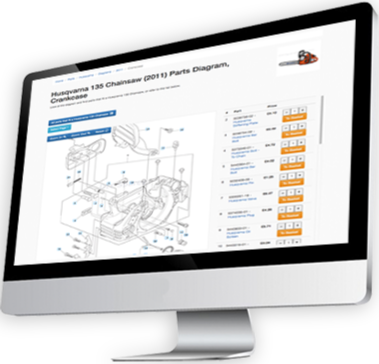
The main route, and the one the site is built around. Every Husqvarna machine we stock has its own set of exploded diagrams: engine, ignition, fuel system, cutting equipment, controls, chassis. Every component is numbered and the part number is listed alongside.
To use them:
- Start at the Husqvarna parts hub and choose your machine type
- Select your model from the list
- Choose the diagram set matching your PNC or production year
- Work through the diagrams to find your part
Best for anyone who knows their PNC and wants to identify a specific component visually before ordering. Particularly useful on chainsaws and tractors, where seeing how an assembly fits together tells you whether you need one part or three.
Option 2: Check the Quick Reference Guides
Curated lookup content in the Help and Advice section. The Quick Reference Guide to Husqvarna Trimmer Heads is the most useful one for Husqvarna owners, covering the Tap-N-Go range with full fitment lists and thread sizes.
Best for confirming a specification before you order, particularly on consumables where the difference between two options is a single measurement.
Option 3: Send us a photo via the Contact Us button
The free identification service. Click Contact Us at the bottom of any page on the site, send a photo of the ID plate along with a description of the part you need, and we'll find it.
Best for anything the first two routes don't resolve: a plate you can't read, a machine you can't find in the diagrams, a 917-numbered Sears-built machine, a cross-brand question, or a part that's been superseded.
Worth knowing:
- We supply genuine OEM parts only. No aftermarket copies.
- We ship worldwide on a tracked service from our warehouse in Shaftesbury, Dorset.
- The service is free and carries no obligation, and you don't need to have bought from us before.
Common questions Husqvarna owners ask
Which number do I need to order Husqvarna parts?
The PNC. It's the nine-digit number on the ID plate, often printed with spaces (for example 970 55 93-00) and used without them (9705593-00). The model number alone will usually get you to several possible diagram sets rather than the right one, and the serial number identifies your individual machine rather than its specification.
How old is my Husqvarna?
The serial number tells you. On modern plates the first four digits are the production year, so a serial reading 2023 1807826 indicates a 2023 machine. On older professional machines the format encoded year, week and sequence in nine or eleven digits, so 054200362 would be week 42 of 2005.
My mower's model number starts with 917. Is it a Husqvarna?
Very likely, yes. Husqvarna manufactured outdoor power equipment for other retailers under house brands for many years, most notably for Sears in the United States, and those machines typically carry model numbers beginning 917. Send us a photo of the plate and we'll confirm what you've got and what parts are available.
Are McCulloch, Flymo or Jonsered parts the same as Husqvarna parts?
Sometimes. All three are Husqvarna Group brands, which means shared factories, shared engineering and a genuine amount of component crossover, particularly on machines of similar class and vintage. It isn't universal, and the professional Husqvarna range in particular uses components you won't find elsewhere in the group. If you've got a part number and want to know whether it crosses, send it to us and we'll check.
Can I still get parts for an older Husqvarna?
In most cases, yes. Husqvarna's parts support runs deep, and machines from the 1990s and 2000s are generally still serviceable. Some individual components on the oldest machines have been discontinued, but a superseded equivalent is often available that fits and functions identically. Send us the PNC and we'll tell you what's currently obtainable.
What chain fits my Husqvarna chainsaw?
Three measurements have to match: the pitch (the spacing between drive links), the gauge (the thickness of the drive links), and the drive link count (which depends on your bar length). All three are specific to your machine and bar combination. The parts diagram for your PNC will show the correct specification, or send us your machine details and we'll confirm.
Are parts still available for older Automower models?
Generally yes. Husqvarna has been producing robotic mowers since 1995, and blades, wheels, charging components and boundary wire are widely available across the generations. Some early-generation electronic components have been superseded. Send us the model and a photo of the underside and we'll tell you what we can supply.
Do you ship Husqvarna parts outside the UK?
Yes, worldwide on a tracked service, excluding sanctioned territories. We regularly send Husqvarna parts to Australia, New Zealand, the United States, Canada, South Africa, Ireland and across Europe. Rates and delivery times are calculated at checkout once you've added a part to the basket and entered a delivery address.
Husqvarna machines tend to outlast their owners' expectations, which is why the parts catalogue stretches back as far as it does. Three things worth remembering when you order: the PNC is the number that matters, the ID plate moves around depending on what type of machine you've got (and on some chainsaw models it isn't where you'd expect), and if a part is hard to find under Husqvarna it's always worth asking whether McCulloch, Flymo or Jonsered list the same component. If you get stuck at any point, the Contact Us button is at the bottom of every page on the site, including this one.